Cooling Water Pumps: Types, Working, Applications & Selection
Cooling water pumps are used to circulate water through cooling systems to remove heat from industrial equipment, processes, heat exchangers, condensers, and other systems.
They play an important role in maintaining controlled operating temperatures across manufacturing and processing facilities.
Depending on the application, cooling water pumps can be integrated with cooling towers, chillers, heat exchangers, process equipment, or closed-loop circulation systems. Pump selection depends on required flow, pressure, water temperature, system resistance, and operating conditions.
What Are Cooling Water Pumps?
Cooling water pumps are mechanical devices that move water through a designated cooling circuit. The circulating water absorbs heat from equipment or a process and transfers that heat to another part of the cooling system.
A cooling water system can be configured as:
- Open-loop cooling
- Closed-loop cooling
- Cooling tower circulation
- Chilled water circulation
- Process cooling
- Condenser water circulation
A typical pump installation may include a pump, motor, piping, valves, filters, pressure gauges, temperature sensors, and control equipment.
Types of Cooling Water Pumps
Centrifugal Cooling Water Pumps
Centrifugal pumps use a rotating impeller to move water through the system. They are widely used because they can provide continuous flow and can be configured for a broad range of capacities.
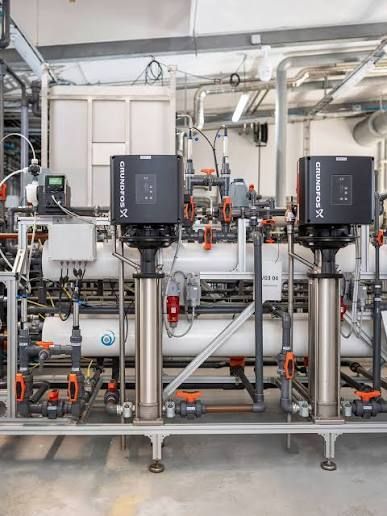
Vertical Cooling Water Pumps
Vertical pumps are useful in installations where space or water-source configuration requires a vertical arrangement. Some designs are used for cooling tower and basin applications.
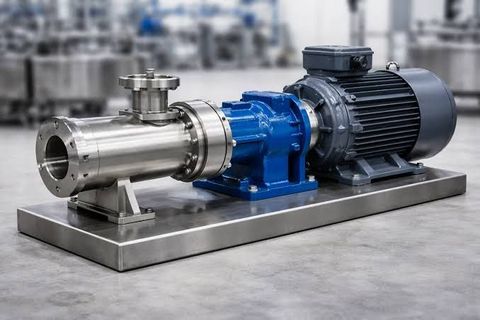
Horizontal Cooling Water Pumps
Horizontal pumps can be installed on a base or skid and are commonly integrated into industrial cooling-water piping networks.
End-Suction Pumps
End-suction centrifugal pumps use an axial inlet and radial discharge arrangement. They can be suitable for smaller and medium-sized cooling circuits.
Split-Case Pumps
Split-case pumps are frequently used in larger cooling systems requiring substantial water flow. Their construction can provide convenient access to internal components during maintenance.
How Cooling Water Pumps Work
Cooling water pumps operate by continuously moving water through a heat-removal circuit.
1. Water Entry
Water enters the pump through the suction connection from a cooling tower basin, reservoir, chiller circuit, or process loop.
2. Pumping Action
The pump's impeller transfers mechanical energy to the water.
3. Pressure Generation
The pump generates sufficient pressure to overcome piping resistance, elevation changes, valves, heat exchangers, and other system components.
4. Heat Transfer
The circulating water passes through equipment or heat exchangers where it absorbs heat.
5. Heat Rejection
The heated water moves toward a cooling tower, chiller, radiator, or other heat-rejection component.
The cooled water then returns to the circulation loop.
Main Components
| Component | Function |
|---|---|
| Pump casing | Directs water through the pump |
| Impeller | Generates water flow |
| Motor | Provides mechanical power |
| Shaft | Transfers rotational energy |
| Bearings | Support rotating components |
| Mechanical seal | Limits leakage |
| Suction piping | Supplies water to the pump |
| Discharge piping | Delivers water to the cooling circuit |
| Valves | Control and isolate flow |
| Control system | Monitors and regulates operation |
The exact configuration depends on the cooling system and pump design.
Applications of Cooling Water Pumps
Manufacturing Plants
Industrial cooling water pumps can circulate water through production equipment, hydraulic systems, furnaces, compressors, and other heat-generating machinery.
Power Generation
Power plants use large-scale water circulation systems for condenser cooling, auxiliary equipment, and other heat-removal processes.
Chemical Processing
Chemical facilities use cooling water to control process temperatures, cool reactors, condensers, heat exchangers, and other equipment.
HVAC Systems
Cooling pumps can circulate chilled water through air-conditioning systems, chillers, cooling towers, and building heat exchangers.
Data Centers
Cooling water systems can support thermal management in facilities containing high-density computing equipment and associated cooling infrastructure.
Food and Beverage Processing
Cooling water can be circulated through heat exchangers, refrigeration systems, processing equipment, and other thermal-control applications.
Cooling Water Pump Performance Parameters
Several technical parameters influence pump selection and system performance.
| Parameter | Importance |
|---|---|
| Flow rate | Determines the volume of cooling water circulated |
| Pump head | Defines pressure available to overcome system resistance |
| Water temperature | Influences equipment and material requirements |
| System pressure | Defines operating conditions |
| Pipe size | Affects hydraulic losses |
| Pump speed | Influences flow and head |
| Motor power | Determines drive capacity |
| NPSH | Helps evaluate suction conditions |
The pump should be selected according to the actual hydraulic requirements of the complete cooling system.
Open-Loop vs Closed-Loop Cooling
| Feature | Open-Loop Cooling | Closed-Loop Cooling |
|---|---|---|
| Water circulation | Water may be exposed to the environment | Water remains within a defined circuit |
| Typical equipment | Cooling towers, once-through systems | Heat exchangers, chillers |
| Water treatment | Often important | Still important |
| Heat rejection | External cooling source | Dedicated heat exchanger or cooling equipment |
| Common application | Large industrial cooling systems | Process and equipment cooling |
The appropriate configuration depends on heat load, water availability, environmental conditions, and process requirements.
How to Select Cooling Water Pumps
Pump selection should begin with the cooling load and hydraulic requirements.
Important factors include:
- Required water flow
- Total dynamic head
- Water temperature
- Cooling load
- Pipe dimensions
- System pressure
- Water quality
- Cooling tower configuration
- Heat exchanger requirements
- Continuous operating conditions
- Motor capacity
- Pump material
For systems using treated or chemically conditioned water, wetted materials should be compatible with the water chemistry.
Automation and Control
Modern cooling water pump systems can incorporate automated controls to maintain required flow and temperature conditions.
Monitoring systems may track:
- Supply temperature
- Return temperature
- Flow rate
- Pump pressure
- Motor status
- Vibration
- Water level
- System alarms
Variable-frequency drives can adjust pump speed according to cooling demand in suitable applications. This can help match pump operation with changing system conditions.
Maintenance Considerations
Routine maintenance is important for maintaining cooling water circulation.
Typical activities include:
- Inspecting mechanical seals
- Checking bearings
- Monitoring vibration
- Checking motor alignment
- Inspecting couplings
- Monitoring flow and pressure
- Checking valves
- Inspecting filters and strainers
- Reviewing water quality
- Checking electrical connections
Cooling systems should also be monitored for scaling, corrosion, biological growth, and debris where these conditions are relevant to the installation.
Conclusion
Cooling water pumps provide continuous water circulation for removing heat from industrial processes, equipment, condensers, heat exchangers, HVAC systems, and other applications. Centrifugal, vertical, horizontal, end-suction, and split-case configurations can be selected according to system requirements.
Proper selection requires consideration of flow, head, cooling load, water temperature, piping, water quality, pump materials, motor capacity, and operating conditions. Regular maintenance and appropriate monitoring can help maintain reliable cooling-water circulation and stable system performance.

Related Post...
Industrial Vacuum Pumps: Types, Working, Applications & Selection
Updated: September 19, 2026
Read More
Industrial Fire Pump Systems: Types, Components & Applications
Updated: September 19, 2026
Read More
Metering Pump Systems: Types, Working, Applications & Selection
Updated: September 19, 2026
Read More